
Don't Let Retirement Turn You Into a Sloth
See if you can relate to this.
... So, here I am in retirement;
No more rushing off to work, no more traffic every morning, no more work schedules, deadlines and meetings. At first, it feels wonderful.
Finally, you can sleep a little later. You can enjoy a slow breakfast. You can read a book when you feel like it. You can have that extra cup of coffee without watching the clock.
But then something happens.
You start noticing little changes.
Perhaps your trousers feel a little tighter around the waist.
Or maybe you are finding it slightly harder to get up from your favourite chair.
Perhaps your balance is not quite what it used to be. You may even notice it when you lift one foot in the shower to dry it.
And then there is the stiffness.
Your lower back complains. Your knees feel a little less cooperative and walking upstairs leaves you more breathless than it used to.
Can you relate?
Retirement can change more than your daily routine.
When we retire, our daily activity often drops without us even noticing.
For years, work may have provided a natural structure to our day. We walked to the car. We climbed stairs. We moved around the office or workplace. We went shopping. We rushed to appointments. We were simply busy.
Then retirement arrives. And suddenly, there is much less reason to move.
Because we have more time at home, another temptation appears. …Food.
The retirement snack trap.
Now that you are home all day, it becomes remarkably easy to snack.
A rusk or two with your morning coffee seems harmless, then perhaps a few biscuits with your ten o’clock tea. When you walk past the cookie jar, you think, “Why not?”
After all, you are retired. You deserve to spoil yourself.
Later, you settle down with a good book. So, naturally, you prepare a little snack bowl. A few pieces of biltong, some nuts, a few blocks of chocolate, perhaps some chips and dried fruit. Nothing seems excessive on its own.
However, add those little extras together every day and the story can change.
Before long, you may find that your waistline is expanding along with your free time.
Your body needs a little more help as you get older.
There is another important part of the story.
As we age, our bodies change. Our metabolism can slow down. We can lose muscle mass and flexibility. Recovery can also take longer.
That means we cannot always rely on our bodies to keep themselves in reasonable shape.
When we were younger, we could sometimes get away with being inactive for a while.
Now, however, we need to become more deliberate.
We need to move because we want to keep moving.
That may sound obvious, but it is an important retirement lesson.
Less movement can become a downward spiral.
Think about what can happen when we become less active.
You move less.
As a result, your muscles may become weaker.
You become less flexible.
Your joints may feel stiffer.
Walking becomes less comfortable.
Your balance may deteriorate.
You become less confident about moving around.
So, you move even less.
And there is the danger.
What started as a comfortable retirement can slowly become a less active lifestyle.
Add frequent snacking and larger meal portions to the mix, and weight gain can make movement even harder.
It becomes a downward spiral.
Less movement leads to less confidence, which can lead to even less movement.
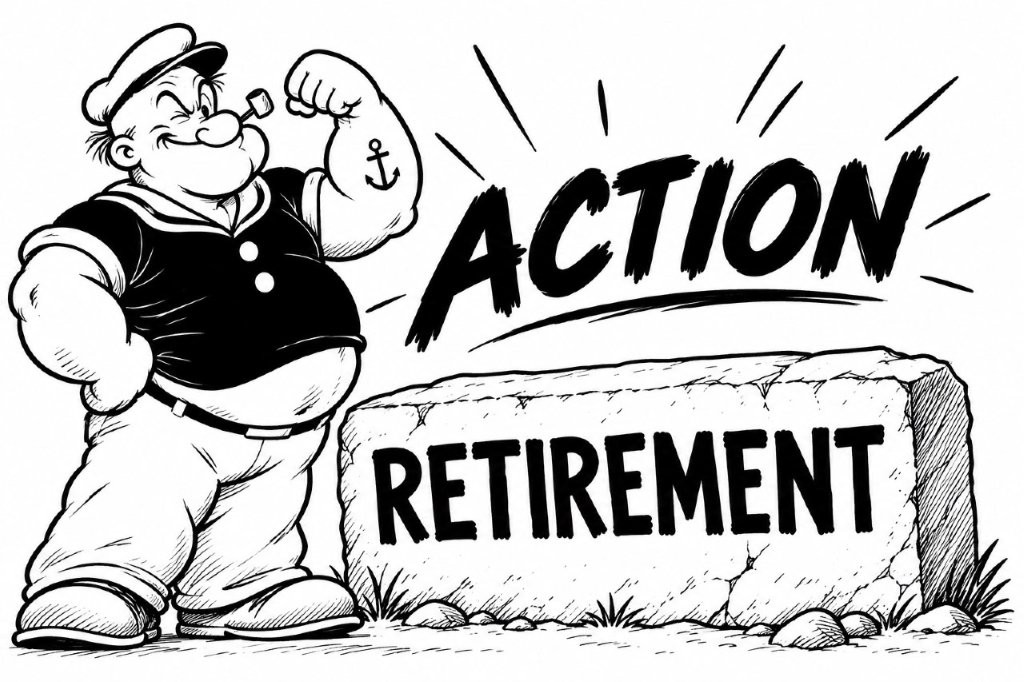
The good news is that you can break that cycle. Retirement requires ACTION.
This is where the word ACTION becomes important.
You can make a decision today that you are not going to become a retired sloth, but a decision without action is merely a wish.
A decision must be followed through by action.
That does not mean you need to become a gym fanatic.
It does not mean running marathons or spending hours lifting weights.
Instead, it means becoming more intentional about your health and your daily movement.
Most importantly, remember this:
Good intentions do not change your lifestyle.
Action does.
Here are six simple actions you may take.
1. Be realistic about your meal portions.
You do not necessarily have to give up the foods you enjoy. However, the combination of food types as well as portion size matters.
As your activity level changes, your food requirements may change too.
Start by becoming aware of how much you are putting on your plate.
Eat slowly. Give your body time to tell you that you have had enough.
And remember that retirement is not a reason to eat as though you are still doing a physically demanding job every day.
A good combination of food types on your plate can be:
Vegetables and Salads | 40-50% |
Protein | 30-35% |
Carbohydrates | 15-20% |
Healthy Fat | Small Amounts |
Sugar.
For retirees, the goal should generally be to keep added sugar low.
Sugar naturally present in whole fruit, vegetables and dairy is healthier than added sugar in sweets, biscuits, cakes, sugary drinks and many processed foods.
2. Break the habit of constant snacking.
The problem may not be one large meal. It may be all those little extras between meals.
Coffee and a rusk.
Tea and a biscuit.
Something while reading.
Something while watching television.
Something before bed.
Try becoming more aware of why you are eating.
Are you actually hungry, or are you simply bored, relaxed, or looking for something to do? That simple question can make a big difference.
Learn more about the impact that snacking has on our health.
3. Stop eating automatically while watching or reading.
There is something particularly dangerous about distracted eating.
When we are concentrating on a television programme or a good book, we may not notice how much we are eating. Before long, the bowl is empty.
Instead, try separating the two activities.
Enjoy your book, or your television programme.
Then enjoy your food when you actually decide to eat.
You may be surprised at how much less you consume.
4. Make movement and exercise part of your retirement routine.
Your joints, muscles and body need regular movement.
Therefore, create a simple daily exercise routine. It does not have to be active gym sessions. Simply stay or get into shape. Stretch, move, walk .
Add some Moderate-Intensity Activity to your exercise routine.
The ideal “sweet spot” for most older adults is to get your heart beating faster and you breathe harder, but you can still comfortably talk in full sentences—though you cannot sing.
You do not have to start with an ambitious exercise programme. In fact, starting too aggressively can make it harder to continue.
Start at a level that suits your current fitness. Then build from there.
5. Make walking part of your day.
Walking is one of the simplest ways to become more active.
If you are already reasonably fit, aim to walk regularly and gradually increase your distance and pace.
However, if you are completely unfit or perhaps you have not walked properly for years, start somewhere comfortable.
Mall walking can be a surprisingly good starting point.
By mall walking, we do not mean strolling at a leisurely pace, but rather walking passages briskly from one side to the other.
The benefits are that you have a flat surface, you are protected from excessive heat and rain and you have access to toilets. There may even be a coffee shop waiting for you afterwards. Most importantly, you are moving.
But do not make mall walking your final destination. As your fitness improves, take your walking outdoors. Introduce gentle slopes and slightly uneven surfaces. Gradually challenge your muscles, coordination and balance.
The objective is not simply to walk further.
It is to become more capable in everyday life.
6. Work on your balance.
Balance becomes increasingly important as we get older.
Fortunately, you can include simple balance exercises in your everyday routine. For example, while brushing your teeth, try standing on one leg for a short period. Then change legs.
Start with whatever feels safe and manageable.
If you feel unstable, hold onto a suitable support rather than risking a fall. Over time, simple exercises like this can become part of your normal routine.
If you have significant balance problems, pain or other health concerns, speak to an appropriate healthcare professional before starting a new exercise routine.
Don’t wait until you have a problem.
This is perhaps the most important message in this post.
We often take action only after something goes wrong.
- We wait until our clothes no longer fit.
- We wait until climbing stairs becomes difficult.
- We wait until our knees hurt.
We wait until our balance becomes a concern. - We wait until our doctor tells us that we need to become more active.
- Why wait?
Retirement gives us something incredibly valuable. It gives us time.
We can use that time to become less active and less capable.
Or we can use it to build a healthier and more enjoyable retirement lifestyle.
You don’t have to change everything at once.
Do not look at this list and think you have to transform your life tomorrow. You don’t.
Choose one thing.
Perhaps start with a daily walk.
Or reduce the snacking.
Maybe start doing some gentle stretching.
Then build another healthy habit around it.
Small actions, repeated consistently, can become powerful habits.
And those habits can help you stay mobile, independent and confident for longer.
Retirement is not the end of the road.
Retirement should give you more freedom, not less ability. You worked for years to reach this stage of life. Now you have an opportunity to enjoy it.
Travel.
Visit family.
Explore new places.
Take up a hobby.
Spend time outdoors.
Play with the grandchildren.
Go camping.
Walk along the beach.
Whatever gives you pleasure, you want your body to be able to keep up with your plans.
So, retire into a life of action.
The goal is not to turn back the clock.
The goal is to make the most of the years ahead.